policy
Road Pricing Coalition publishes first report as fuel duty receipts head towards near zero
The plant-hire trade body is a member of the cross-industry coalition, whose first report sets out five principles for any future road pricing system as the government prepares a per-mile tax on electric cars from 2028.
The Road Pricing Coalition, a cross-industry group of trade associations and organisations that use the UK road network, has published its first report, the Construction Plant-hire Association (CPA) has announced.
The CPA said it is a member of the coalition, which it describes as a collective voice in the debate on the future of road pricing and taxation in the UK. The report, the association said, is an introduction to that debate and rests on five principles for any future approach.
Chris Casley, CPA Policy Director, said: "The transition to cleaner vehicles will not happen at the same speed across every part of the economy. Specialist and heavier commercial fleets face very different constraints around vehicle availability, range, payload and charging infrastructure."
He added: "Future taxation needs to recognise those differences and avoid placing disproportionate costs on businesses with limited alternatives."
The five principles
According to the CPA, the coalition's first principle is business engagement throughout policy design, testing, implementation and review.
The second calls for alignment with wider government objectives, including economic growth, productivity, competitiveness, supply chain security and decarbonisation.
The third seeks fair and proportionate treatment across sectors, vehicle types and regions, including comparable treatment of UK and overseas operators using the same roads, while recognising the economic contribution of commercial road users.
The fourth is phased, transparent and evidence-led implementation, and the fifth is coordination and interoperability across national, devolved and local schemes.
The policy background
The coalition's report lands as the government prepares to introduce a per-mile charge on electric cars. HM Treasury announced electric vehicle excise duty (eVED) at Budget 2025 and ran a consultation on its implementation from 26 November 2025 to 18 March 2026.
In its response to that consultation, the government said it remains committed to introducing eVED from April 2028. The consultation received 5,133 responses.
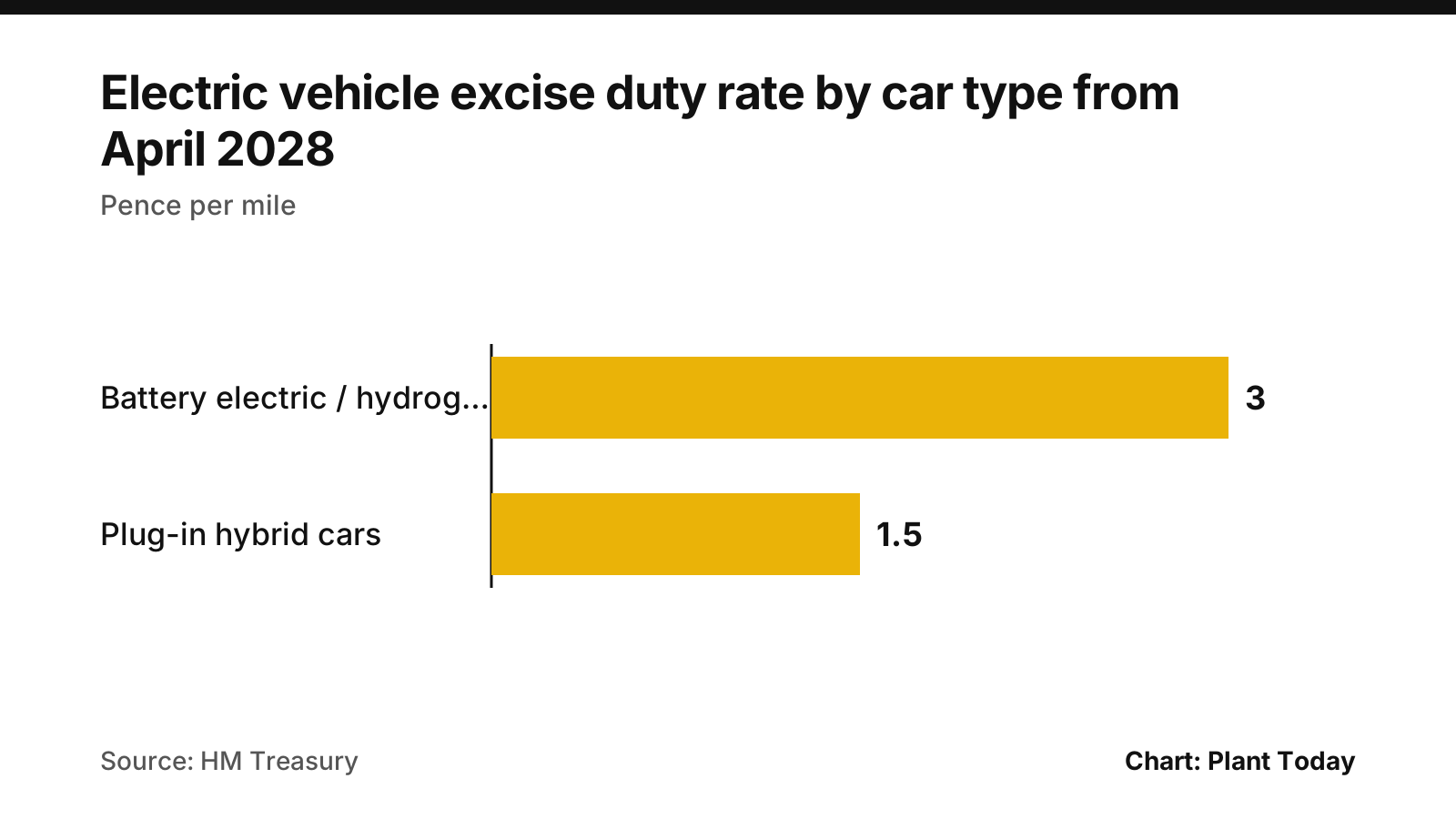
The Treasury has set the rate at 3 pence per mile for battery electric and hydrogen fuel cell cars, and 1.5 pence per mile for plug-in hybrid cars.
| Vehicle type | eVED rate (pence per mile) |
|---|---|
| Battery electric and hydrogen fuel cell cars | 3 |
| Plug-in hybrid cars | 1.5 |
Commercial vehicles are not covered at the outset. According to the government's consultation response, vans, buses, coaches and HGVs will be out of scope of the tax when it is introduced.
The revenue at stake
The scale of the fiscal issue is set out by the Office for Budget Responsibility (OBR). It expects fuel duties to raise £24bn in 2025-26, which would represent 1.9% of all receipts.
The OBR attributes part of the trend in fuel duty receipts to the continued decline in the volumes of fuel consumed, driven by the shift to electric vehicles.
The government's consultation response goes further, saying that as the transition to electric vehicles accelerates, fuel duty receipts are set to decline to near zero by 2050.
The CPA has published a link to the full coalition report on its website. The eVED charge on electric cars is due to start in April 2028.
Sources
- Construction Plant-hire Association (CPA) (opens in a new tab) (accessed 2026-10-15)
- Office for Budget Responsibility (opens in a new tab) (accessed 2026-10-15)
- HM Treasury / GOV.UK (opens in a new tab) (accessed 2026-10-15)
- HM Treasury / GOV.UK (opens in a new tab) (accessed 2026-10-15)
This story was researched from the primary sources above and checked against them before publication. Spotted an error? Tell us and we will correct it promptly.